
“There is perhaps no central theme to American national identity than the land. Over the years, it has served as a wellspring of aesthetic beauty, spiritual sustenance, and economic opportunity.”
Thus reads a wall sign at the Corcoran Gallery of Art beneath the title “Nature as Nation: 19th Century American Landscapes from the Collection.” The display in this gallery is anchored by Niagara, the seminal 1857 painting by Frederick Church, and The Last of the Buffalo, an 1888 painting by Albert Bierstadt. The first is an image from Church, the prized pupil of Thomas Cole, the founder of the Hudson River School, a group of artists whose common thread was to create realistic, elegiac, and grand landscape paintings on large oversized canvases. Cole’s arch-rival for popularity during the late 1800s was Bierstadt, who ventured west during the country’s expansion and settlement, providing eastern audiences with composites of actual landscapes. Both men romanticized landscape, and today landscape remains a primary focus for artists worldwide.
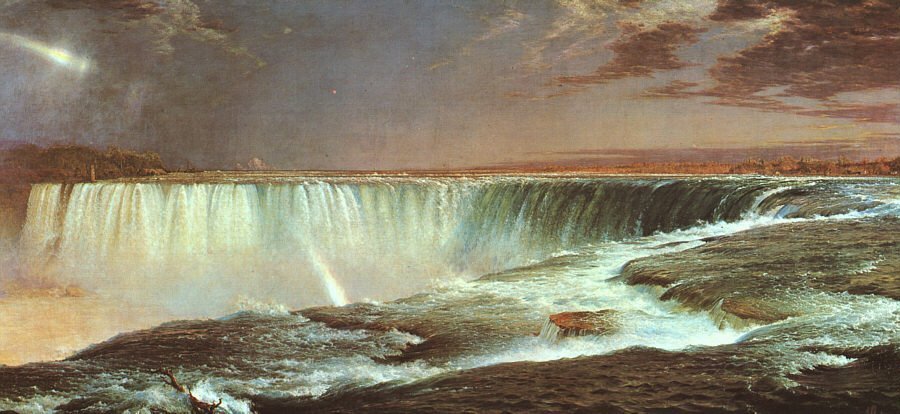
These corrupted yet glorified landscape paintings have influenced generations of artists who continue to idealize the land and present a utopian version of history on their canvases. In the West and Southwest, landscape painting still reigns today and provides viewers a storybook version of Americana. And while the land and landscape weave their way through modern and contemporary American art in unique and unusual ways, providing an experience of nature that is more than nation-building, it begins with an aesthetic journey that is emotional and passionate, not necessarily grounded in truth or reality.
Charles Baudelaire defined romanticism as “precisely situated neither in choice of subject nor exact truth, but in the way of feeling.”
The Corcoran Gallery curators tell us in their signage: “For a young country, challenged to define itself, in the absence of an official history, the vast forests, fertile plains and great mountains of North America provided an important source of pride.”
Provided and still provide. The American landscape draws foreign visitors longing to see the wide-open spaces, huge waterfalls, grand red rock canyons, and towering snow-covered peaks glorified in the Hudson River school paintings. And in our urban environments, we have gone to great lengths to present unified visions of utopia, particularly in Washington DC, designed to be a capital city, the landscape was systematically planned to give a palatial Beaux-Arts style around a long length of park and greenbelt anchored and dotted with memorials to presidents and war heroes primarily.
During the 1960s and 1970s, the American landscape offered seemingly endless opportunities for aesthetic invention. Consider Nancy Holt’s Sun Tunnels, massive concrete tubes placed in the Great Basin Desert outside Lucin, Utah, and considered seeing devices for tracking the positions of the sun, earth, and stars. Holt’s husband, artist Robert Smithson created Spiral Jetty, a counterclockwise coil built of mud and salt in the Great Salt Lake, which was unintentionally submerged under water and reappeared during a recent drought in 2004. Walter De Maria’s Lightning Field is 400 stainless steel poles installed in a grid array in the Western New Mexico desert, and James Turrell’s ever-elusive finally completed Roden Crater is an inverted planetarium built into the cone of a volcano near Flagstaff, Arizona and was chosen because of its relationship to the sky and celestial movements. This land art emerged with the growing ecology movement in the United States and changed how people thought of art by taking it out of the gallery or museum into the natural landscape. The environment was no longer recreated on canvas; these works engaged the environment.
Unlike much-commercialized art during this period, land art could not be bought or sold on the art market. Thus, it shifted the perspective of how people worldwide viewed art. And since the works were often created in remote and out-of-the-way locations in the Southwest, they were documented via film and photography, which could then be exhibited, viewed, and provide a secondary experience.
While on the surface, this land art seems pure and uncorrupted and less romanticized than the landscape paintings of Church and Bierstadt, the remote and uninhabited region of the country selected by most land artists to create their works implies another level of fanciful and visionary thinking related to the land by these artists. America was in turmoil during the 1960s and 70s—the Vietnam War, Civil Rights, Feminism, and Gay Rights all came to a head and clashed. These artists turned to what H.H. Arnason called “the open, uncorrupted land of the West” to create their utopian visions. Anyone who calls the land of the West uncorrupted has clearly never lived in the West where the land has been a battleground for Native Americans, Spanish conquerors, French conquerors, cowboys, ranchers, sheepherders and now is corrupted by development and battles over water rights and ownership of the prized views and vistas.
Where the land artists attempted to take the art out of the gallery and put it into the land, artist Maya Lin, also on exhibit at the Corcoran Gallery, attempts to bring the land back inside the gallery. Her works are built into and built of the earth, but she also explores bringing the experience of a particular landscape, a body of water, an island, and a mountain range into a closed structure. The viewer experiences elements of the landscape without ever venturing into that landscape.

The Vietnam Memorial, completed in 1982, Lin’s first artwork is also a work of land art or landscape architecture. It is imbued with text and history, and she calls it a “systematizing landscape.” A wedge dug into the ground, the memorial is a scar or mark on the land, just as the war was a scar and marked our country in ways that have forever changed and shifted our destiny. The memorial is two black marble walls that meet at an angle and simply list the names of all 58,195 U.S. soldiers who died in the unpopular war. While somewhat controversial when it was first installed, today, the memorial ranks number ten on The List of America’s Favorite Architecture.
All these artists express themselves through the landscape, some through work built into and built of the earth. Whether subjective, poetic, or romantic, the landscape continues to prevail as a dominant genre in American art.

 Leanne Goebel
Leave a comment